

What is an enlarged prostate (BPH)?
As men age, the prostate gland can enlarge, resulting in a common condition called Benign Prostatic Hyperplasia (BPH).
This extra tissue presses against the urethra and bladder, causing frustrating urinary symptoms that affect daily life and sleep quality.
Treat Enlarged Prostate Without Surgery
Find relief from frequent urination, urgency, and sleepless nights with a simple, minimally invasive procedure.
Prostate Artery Embolization (PAE) at RIVEA, Hyderabad helps you get back control of your bladder and your life — no surgical cuts, no general anaesthesia, no hospital stay.
Consult our interventional radiology team to find out if PAE is right for you.
Book your consultation today
Common symptoms
 Frequent urination, especially at night
 Weak or interrupted urine flow
 Urgency or difficulty starting urination
 Feeling that the bladder isn’t fully empty
 Interrupted sleep and fatigue
Common symptoms
Frequent urination, especially at night
Weak or interrupted urine flow
Urgency or difficulty starting urination
Feeling that the bladder isn’t fully empty

Interrupted sleep and fatigue
Left untreated, BPH can lead to urinary tract infections or bladder strain. But you don’t need to rush into surgery. PAE offers an effective alternative with faster recovery and lasting results.
What is Prostate Artery Embolization (PAE) ?
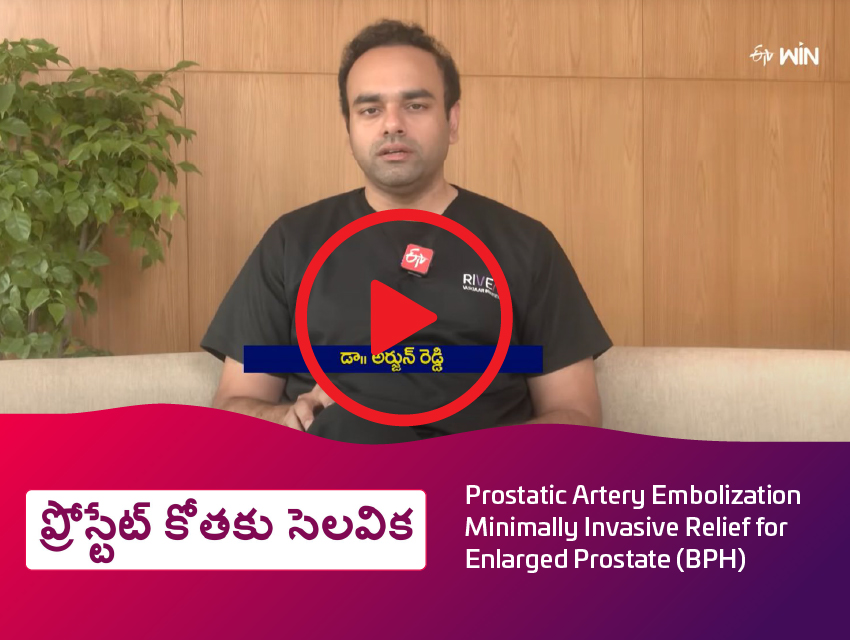
Prostate Artery Embolization (PAE) is a cutting-edge, minimally invasive procedure that reduces prostate size by blocking the small blood vessels that supply it.
With less blood flow, the prostate gradually shrinks, relieving pressure on the urinary tract and improving flow.
It’s done through a pinhole access in the wrist or groin and requires no stitches or cuts.
At RIVEA, PAE is performed using the Allia IGS 7, GE HealthCare’s advanced AI-powered 3D imaging system for precision-guided treatments, ensuring accuracy, safety, and minimal radiation exposure.
How Prostatic Artery Embolization (PAE) works
- Performed through a pinhole in the groin or wrist, no surgical incision requierd
- Guided by live imaging using the Allia IGS 7 system
- Tiny particles are delivered to the arteries feeding the prostate
- Procedure time: about 60–90 minutes
- Discharge: usually the same day
Why choose a non-surgical option?
- No surgery or hospital admission
- Minimal pain or discomfort
- Resume normal activity in 1–2 days
- Noticeable relief within weeks
- Long-term improvement in urinary flow and sleep
- Preserves sexual function
What to expect on the day of PAE?
Before the procedure
- Quick assessment by our interventional radiologist
- Imaging to map your prostate blood flow
During the procedure
- 60–90 minute procedure
- No general anaesthesia
- Same-day discharge
After the procedure
- Return to light activity in 24–48 hours
- Noticeable relief within 1–2 weeks
- Maximum results in 1–3 months
What to expect after Prostatic Artery Embolization (PAE)
- Same-day discharge; mild urinary symptoms may persist briefly
- 1–2 weeks: noticeable improvement in frequency and sleep
- 1–3 months: maximum relief as the prostate shrinks
- Long-term: improved urinary flow and quality of life
How does PAE measure up against other enlarged prostate treatments
| Aspect | PAE (Prostate Artery Embolization) | TURP (Transurethral Resection of Prostate) | Laser Therapy / HoLEP | Medication |
|---|---|---|---|---|
| Invasiveness | Minimally invasive (via a small wrist or groin puncture) | Surgical (via urethra) | Surgical (via urethra) | Non-invasive |
| Anesthesia | Local anesthesia | General / spinal | General / spinal | None |
| Hospital Stay | Same-day discharge | 2–3 days | 1–2 days | None |
| Recovery Time | 1–3 days | 2–4 weeks | 1–2 weeks | Ongoing |
| Effect on Sexual Function | Preserved | Often affected | May be affected | Preserved |
| Catheter Use | Usually not required | Required (1–3 days) | Required (1–2 days) | Not applicable |
| Durability of Results | Long-term (≥5 years) | Long-term | Long-term | Temporary / Symptom control only |
| Ideal For | Men unfit or unwilling for surgery; enlarged prostate (>60 cc) | Fit for surgery | Fit for surgery | Mild symptoms |
| Complication Rate | Very low | Moderate | Moderate | Minimal |
Prostatic Artery Embolization at RIVEA:
Precision backed by GE Allia IGS 7
- Next-generation image guidance for pinpoint accuracy during PAE
- 3D and real-time imaging help precisely target prostate arteries
- Lower radiation and contrast dose for safer procedures
- Seamless head-to-toe imaging without moving the patient
- Robotic, fully mobile system ensures comfort and smooth workflow
- Hybrid-OR ready — easily shifts between imaging and treatment modes
- Designed with doctors for patients — ergonomic, fast, and reliable
Why choose RIVEA for Prostatic Artery Embolization (PAE)
- Performed by Dr. Arjun Reddy, one of Hyderabad’s leading interventional radiologists & the first to perform PAE in Hyderabad
- State-of-the-art cath lab equipped with Allia IGS 7 for unmatched imaging precision
- Dedicated IR-focused care team
Don’t let an enlarged prostate control your life any longer.
Find out if you’re a candidate for PAE today.
Consultations available at RIVEA Vascular & Interventional Radiology Centre, Hyderabad.
Click here to learn more about:
Prostate Artery Embolization (PAE)
For any inquiries, post your query here:
Ask Rivea
Contact us today to explore your options.
Call Now
Our Team
-

Dr. Arjun Reddy
MBBS, MD
Chief Interventional RadiologistDr. Arjun Reddy is a highly accomplished Interventional Radiologist with extensive international training and a track record of pioneering minimally invasive, image-guided procedures in India.
View Profile Book an Appointment