

Prostatic Artery Embolization (PAE)
Prostatic artery embolization (PAE) is a procedure for men whose enlarged prostate is causing urinary symptoms. An interventional radiologist guides a thin catheter into the arteries that feed the prostate and releases microscopic particles that block part of that blood supply. The gland shrinks over the following weeks and months, and the pressure on the urethra eases.
At RIVEA, we prefer groin access. The catheter goes in through a small puncture in the groin, over the femoral artery. You stay awake under local anaesthesia with light sedation, and will usually go home the same day or at most after one night of observation.
When is PAE performed?
Benign prostatic hyperplasia (BPH) is a non-cancerous growth of the prostate that becomes common after the age of 50. As the gland enlarges it squeezes the urethra, and the bladder has to work harder to empty. While BPH is not a dangerous or life threatening condition, it can certainly reduce a person’s quality of life by wearing down sleep and disrupting their daily routine.
Common complaints include:
- Getting up at night to pass urine (nocturia)
- A slow or hesitant start, and a weak stream
- A feeling that the bladder hasn’t fully emptied
- Sudden urgency, sometimes with leakage
Tablets such as alpha-blockers and 5-alpha-reductase inhibitors are the first line of treatment. In some cases they are ineffectual and in other cases cause side effects such as reduced libido, erectile difficulty or changes in ejaculation. Surgery like Transurethral Resection of the Prostate (TURP) was once the gold-standard treatment though it carries anaesthesia risk, a hospital stay, and a risk of retrograde ejaculation. There have been many developments in treatment options since then, and minimally invasive alternates like PAE are gaining worldwide recognition.
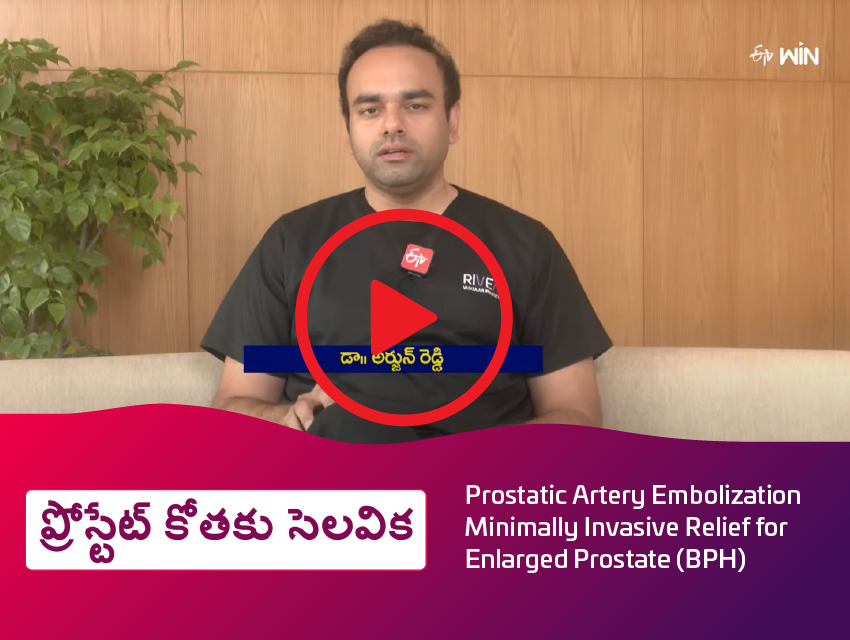
Understanding PAE
Is PAE right for you?
PAE is usually considered for men who have all of the following:
- Moderate to severe symptoms that affect daily life (usually with an International Prostate Symptom Score, IPSS, of about 15 or higher)
- A prostate larger than about 30 cc
- Symptoms that haven’t improved enough on medication, or who can’t tolerate it
- A personal preference to avoid surgery, or a health condition that makes surgery riskier
PAE is also used for some men who depend on a urinary catheter because of an enlarged prostate.
It is not suitable if you have prostate cancer, an active urinary or prostate infection, a significant allergy to contrast dye, or kidney function too poor to tolerate it. Vessel anatomy also matters as a minority of men have prostatic arteries that are too small, twisted or diseased to be reached safely on one or both sides. Imaging before the procedure tells us how likely that is.
Before the procedure
An assessment usually includes:
- A symptom review and IPSS questionnaire
- Digital rectal examination
- Urine tests to look for infection
- A PSA blood test, with further work-up if it is raised, to rule out prostate cancer
- Kidney function tests
- Prostate ultrasound or MRI, and often a CT angiogram to map the arteries
You will be told which regular medicines to continue or pause, and when to stop eating and drinking beforehand.
What happens during PAE
The procedure takes about 1.5 to 2 hours in our interventional radiology suite, using live X-ray (fluoroscopic) guidance and 3D imaging on the Allia IGS 7 system to find the small and variable prostatic arteries.
- The skin over the groin is numbed. You will be awake, with sedation available if you want it.
- A needle puncture is made into the femoral artery and a catheter is placed. No stitches are needed afterwards.
- Contrast dye is injected to show the arteries supplying the prostate.
- A very fine microcatheter is guided into each prostatic artery in turn.
- Embolic particles are released to reduce blood flow to the gland, one side and then the other.
- The catheters are removed and pressure is held over the puncture site, and a small dressing is applied.
Pressure or mild pelvic cramping are common.
Recovery
You will lie flat and rest for a few hours while the groin puncture seals, then go home the same day. It’s like you will be able to go back to desk work within 2 to 5 days. The prostate itself continues changing for months with early symptoms often beginning to ease within 2 to 6 weeks; the gland typically shrinks by 20–30%, with the extent of shrinkage varying between patients and studies. Symptom relief and the change in size might not always correlate exactly. Doctors judge results by how you feel and how you pass urine, instead of depending solely on the scan.
First 24 to 48 hours
- Drink plenty of fluids unless you have been told to limit them, to help clear the contrast dye
- No alcohol and no driving for 24 hours
- Avoid strenuous activity, including climbing several flights of stairs, and limit sharp bending at the hip, for 24 hours
- Eat normally
The puncture site
- Remove the dressing the next day, wash gently with soap and water, and pat dry
- Apply a fresh bandaid daily for 3 days
- Keep the site clean and dry, and avoid creams, lotions and powders, for 5 days
- Don’t lift more than 6 to 9 kg for 7 days, or until the site has healed
What is normal
- More frequent urination, lower abdominal pressure or mild burning for 7 to 14 days
- Blood in the urine or semen for 7 to 21 days
- A small amount of blood in the stool for 4 to 7 days
- A temperature up to 38°C (100.4°F) for a few days
- Bruising or tenderness at the puncture site for 2 to 3 weeks
Call us the same day if you have
- A fever above 38°C (100.4°F)
- Inability to pass urine
- A lump at the puncture site that is growing or pulsating
- Redness, warmth, discharge or worsening pain at the site
- Symptoms that medication prescribed for recovery isn’t controlling
Risks and limitations
PAE is well tolerated by patients and serious complications are uncommon. It does need to be done by an interventional radiologist with specific experience in prostatic artery work, since the vessels are small and some branches run close to the bladder, rectum and penis.
Common and short-lived side-effects
- Bruising or a hematoma in the groin at the puncture site
- Blood in urine, semen or stool
- Bladder irritation and spasms
- Pelvic discomfort and low-grade fever (post-embolization syndrome)
Less common side-effects
- Urinary tract infection or infection of the prostate, in roughly 3 to 5 percent of men, treated with antibiotics
- Temporary difficulty passing urine, sometimes needing a short period of catheterization
Rare side-effects and complications
- Genital skin injury is a rare potential complication of PAE caused by unintended embolisation of blood vessels supplying nearby tissues
- Pseudoaneurysm (a bulge in the femoral artery wall at the puncture site) or injury to the bladder wall or rectum
How PAE compares with other treatments
| PAE | Medication | Rezum | TUIP | TURP | HoLEP | |
|---|---|---|---|---|---|---|
| How it works | Reduces blood flow so the gland shrinks | Relaxes the prostate or shrinks it slowly | Steam destroys obstructing tissue | Small cuts in the prostate neck to widen the outlet | Surgically removes prostate tissue | Laser removes the inner gland |
| Anaesthesia | Local with sedation | None | Local or sedation | Spinal or general | Spinal or general | Spinal or general |
| Recovery | A few days | None, but daily and ongoing | 1 to 2 weeks | 1 to 2 weeks | 3 to 6 weeks | 2 to 4 weeks |
| Sexual side effects | Low | Possible: libido, erections, ejaculation | Low | Lower than TURP, but retrograde ejaculation can occur | High: retrograde ejaculation is common | High: retrograde ejaculation is common |
| Best suited to | Men who want to avoid surgery or anaesthesia | Mild to moderate symptoms | Mild to moderate BPH | Small prostates | Severe symptoms needing the greatest relief | Very large prostates |
Why choose PAE?

Outpatient procedure. You can go home the same day

No general anesthesia, no surgical cuts

Low risk of side effects like incontinence or sexual dysfunction

Quick recovery

Long-lasting symptom relief
Why choose RIVEA for PAE?
RIVEA Vascular Institute provides specialised care for enlarged prostate through Prostate Artery Embolization (PAE), a minimally invasive, image-guided treatment. Our approach combines advanced technology and clinical expertise to help patients explore treatment options with a focus on safety, comfort and recovery.
The team is led by Dr. Arjun Reddy, founder of and Chief Interventional Radiologist at RIVEA, Hyderabad. He specialises in Prostate Artery Embolization (PAE) and other minimally invasive procedures and has previously worked at major hospitals. He performed Hyderabad’s first PAE at AIG Hospitals, helping introduce this treatment to the city. His approach combines procedural expertise with a focus on individual patient needs and care.
What RIVEA offers:

Allia IGS 7 hybrid imaging system for ultra-precise minimally invasive procedures

Patient-first approach focused on comfort and fast recovery

One-on-one guidance from diagnosis through follow-up
FAQs
Does an enlarged prostate mean I have cancer?
No. BPH is not cancer and does not raise your risk of developing it. The two can exist together, which is why we check your PSA and examine the prostate before offering PAE.
How is PAE different from TURP?
TURP removes prostate tissue through the urethra under spinal or general anaesthesia and usually needs a hospital stay of a few days. PAE needs only a puncture at the wrist or groin, local anaesthesia with sedation, and no hospital stay. TURP generally improves urine flow more and needs repeating less often. PAE carries a lower risk of retrograde ejaculation and incontinence. Which one suits you depends on your priorities.
Who performs the procedure?
An interventional radiologist, a doctor trained to treat conditions through catheters under imaging guidance. Your urologist or physician can stay involved in your care, and we are glad to coordinate with them.
Is it painful?
The skin is numbed, and most men feel pressure and some pelvic cramping rather than pain. The cramping, along with a mild fever and burning on urination, can come on over the next few days, and simple medication usually controls it.
How long does it take?
About 1.5 to 2 hours on the table. Plan for the better part of a day at the hospital, as you will rest for several hours before going home.
When will I feel better?
Many men notice some improvement within 2 to 6 weeks. Gains usually continue over the next 3 to 6 months as the prostate shrinks.
Is PAE safe?
For well-selected patients treated by an experienced operator, serious complications are uncommon. Infection, bleeding at the puncture site and, rarely, non-target embolization are the main concerns, and we cover them in the consultation before you decide.
Will it affect sex?
Erections and ejaculation are usually preserved. Retrograde ejaculation and erectile dysfunction are less common after PAE than after TURP. Some men report that sexual function improves once night-time waking and urgency settle.
Will the results last? What if symptoms come back?
For many men the improvement lasts for years, but it is not guaranteed, and symptoms can return as the prostate regrows or the blood supply recovers. Embolization can be repeated in some cases, and surgery stays available if it is not enough.
What does PAE cost in Hyderabad?
The usual range is ₹1,60,000 to ₹2,50,000. The final figure depends on the hospital, the imaging equipment in the cath lab, the type of sedation, your other health conditions, and the tests you need before and after. We give you an estimate after the initial consultation.
Does insurance cover it?
Coverage depends on your insurer and policy. Our team will help with documentation and coordinate with your insurer, and we recommend checking your policy terms before the procedure.
Get Support & Information
Click here to learn more about:
Benign Prostatic Hyperplasia (BPH)
For any inquiries, post your query here:
Ask Rivea
Contact us today to explore your options.
Call Now
Our Team


Have more questions?
Book a consultation at RIVEA Vascular Institute, Hyderabad
- Society of Interventional Radiology Multisociety Consensus Position Statement on Prostatic Artery Embolization for Treatment of Lower Urinary Tract Symptoms Attributed to Benign Prostatic Hyperplasia
- Prostatic Artery Embolisation Versus Transurethral Resection of the Prostate for Benign Prostatic Obstruction
- Transurethral Resection of the Prostate (TURP) Versus Original and PErFecTED Prostate Artery Embolization (PAE) Due to Benign Prostatic Hyperplasia (BPH)
- University College London Hospitals: Prostate Artery Embolisation
- Prostate Artery Embolization for Lower Urinary Tract Symptoms Secondary to Benign Prostatic Hyperplasia
- Johns Hopkins Medicine: What can a man expect from prostate artery embolization?